
МЕДИЦИНСКОЕ ОБОСНОВАНИЕ ЛАЗЕРНОЙ ЭПИЛЯЦИИ С ПРИМЕНЕНИЕМ КОМБИНИРОВАННОЙ МЕТОДИКИ ДВОЙНОГО ВОЗДЕЙСТВИЯ НА ВОЛОСЯНОЙ ФОЛЛИКУЛ
МЕДИЦИНСКОЕ ОБОСНОВАНИЕ ЛАЗЕРНОЙ ЭПИЛЯЦИИ С ПРИМЕНЕНИЕМ КОМБИНИРОВАННОЙ МЕТОДИКИ ДВОЙНОГО ВОЗДЕЙСТВИЯ НА ВОЛОСЯНОЙ ФОЛЛИКУЛ
Аннотация
В статье представлена методика лазерной эпиляции с применением комбинированного двойного воздействия на волосяной фолликул. Описано медицинское обоснование предложенного подхода, основанное на принципе селективного фототермолиза, а также экспериментально подтверждено, что сочетание лазерного облучения и депиляции воском, с повторным применением лазера, усиливает термический эффект при минимизации рисков ожогов и гиперпигментации. По итогам исследования выявлено, что предложенная комбинированная методика двойного воздействия на волосяной фолликул позволяет сократить количество процедур, расширить диапазон фототипов кожи для работы и обеспечить возникновение необходимых эффектов эпиляции при безопасности для пациентов.
1. Introduction
Laser hair removal is one of the most common procedures in modern aesthetic medicine. Traditional technologies such as SHR, HR, and IPL are characterized by a long treatment course and insufficient effectiveness on light hair and dark skin. There also remains a risk of burns and hyperpigmentation, which often occurs at high fluence levels or during the treatment of sensitive areas of the face and neck. To address these issues, a combined dual-impact technique has been proposed. Traditional laser systems primarily rely on melanin absorption, which limits their effectiveness in patients with light hair or darker skin. In addition, only 10–15% of hair follicles are in the active anagen phase during the procedure, which further increases the total number of required sessions. The combined dual-impact approach partially compensates for these limitations by widening the thermal window for follicular destruction. At the first stage, the laser is applied to hair approximately 2 mm in length, after which the hair is removed with wax. The laser is then applied again to the exposed follicle, which increases the thermal effect on the follicle, enhances the efficiency of epilation, reduces the number of sessions, and minimizes the risk of complications .
The aim of this study is to evaluate the clinical effectiveness and medical rationale for using the combined dual-impact technique for hair removal.
2. Research methods and principles
A comparative study was conducted involving 100 women who agreed to participate in the experiment during the procedures. The patients had different skin phototypes (according to the Fitzpatrick scale, I–V) and treatment areas (face, underarms, bikini, legs, and arms). A comparison was made between Groups A and B.
Group A underwent SHR procedures, in which the laser affected only the hair containing melanin. The treatment course consisted of 6–10 sessions with intervals of 4–6 weeks.
Group B underwent the combined technique, which consisted of several stages :
1) initial laser exposure applied to hair approximately 2 mm in length, during which the energy is transmitted through the shaft to the bulb;
2) immediate waxing, during which the hair is removed with the root, exposing the follicular opening;
3) repeated laser treatment along the open channel, allowing the energy to reach the matrix directly.
In working with Group B, devices of the same class (diode/alexandrite SHR lasers) were used as for Group A, with individual adjustment of energy and pulse duration according to the skin phototype. Cooling systems were applied in all cases. The obtained results, comparing Groups A and B, are presented in Figure 1.
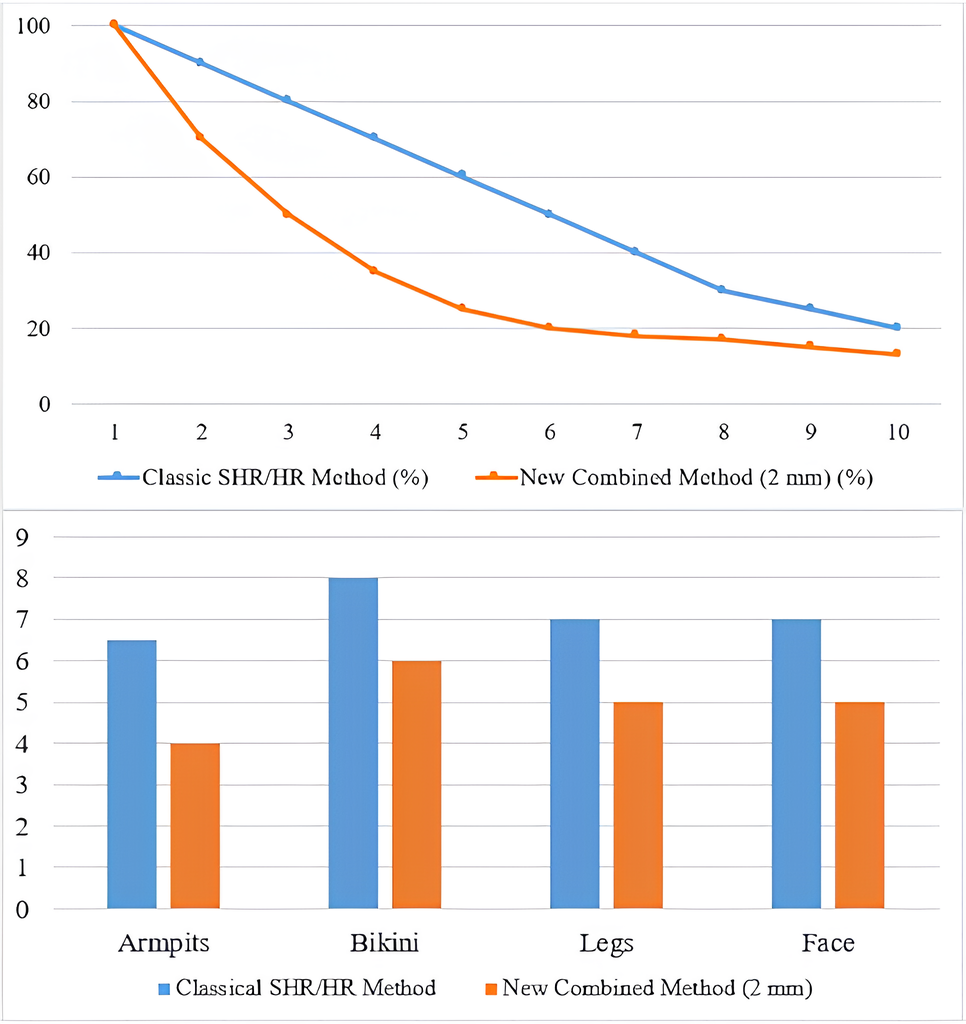
Figure 1 - Comparative analysis of the effectiveness of laser hair removal using the combined dual-impact technique targeting the hair follicle
3. Main results
The conducted experiment demonstrated that the combined technique allows for a faster and more pronounced effect compared to SHR epilation. Based on the obtained results, several observations can be noted:
1) the hair became thinner and shed more quickly. In the traditional scheme, hair density reduction occurred gradually (over 6–10 sessions), while with the new technique, a noticeable decrease was achieved after just 4–7 sessions;
2) the average number of procedures required to achieve the desired result decreased by 20–30% compared to the standard SHR course;
3) the technique proved effective for various skin phototypes. For types I and II (light skin, dark or fair hair), the effect was most pronounced — with intensive hair shedding already after 1–2 sessions, and the number of procedures reduced by approximately 30%. For type III, the reduction in sessions was around 25%, and for types IV–V, about 15–20%. At the same time, darker skin types and thicker hair were successfully treated with minimal fluence during the second stage, which contributed to the absence of adverse side effects during laser hair removal.
In addition, it was observed that the combined approach proved more effective across different body areas. For example, in the underarm region, the average number of procedures was 4–5 (compared to 6–8 with SHR), while on the legs and arms, hair reduction of 70–80% was achieved after just 3–4 sessions. Thus, the combined technique reduces hair density through a dual “thermal impact” on the follicle, leading to a decrease in the number of sessions required across all treated areas.
Waxing mechanically removes the hair shaft and creates an open follicular channel, which reduces optical scattering and allows a greater proportion of laser energy to reach the deeper parts of the follicle, thereby enhancing matrix coagulation.
When analyzing the obtained results, it should be noted that they generally align with existing research. Overall, laser hair removal is considered safe and effective; however, complications such as burns and pigmentary changes typically occur when treating the face and neck areas or when using an alexandrite laser with high fluence levels , . The combined technique made it possible to reduce the required irradiation energy during the second stage (due to the preliminary heating of the hair), thereby minimizing the occurrence of adverse side effects in sensitive areas. At the same time, laser technologies are known to provide high precision and minimal invasiveness, allowing effective targeting of various chromophores , . The author’s approach expands the capabilities of laser hair removal by combining follicular heating with structural effects on the hair shaft while minimizing direct laser exposure.
It is also important to note the safety of the technique, as—with proper parameter selection and the use of cooling systems —complications were minimal. Only isolated reactions were recorded (mild redness, folliculitis, slight burns), which were quickly resolved with standard remedies. When the protocol is followed, the combined technique is safe, and compared to traditional SHR, the number of adverse reactions is reduced.
4. Conclusion
The obtained results demonstrate that the proposed combined dual-impact laser technique is an effective and well-substantiated approach to hair removal. The dual heating of the follicle significantly increases treatment efficiency, reducing the overall course duration by 20–30% compared to classical SHR, while achieving the clinical effects of hair thinning and shedding more rapidly. The technique has proven applicable to a wide range of skin phototypes (I–V) and body areas. At the same time, the incidence of adverse side effects remains low, making the method safe for use. The technique shows particular promise for patients with darker skin phototypes, who traditionally face a higher risk of laser-induced side effects. Further large-scale studies may refine protocol parameters to optimize the balance between efficacy and safety.